
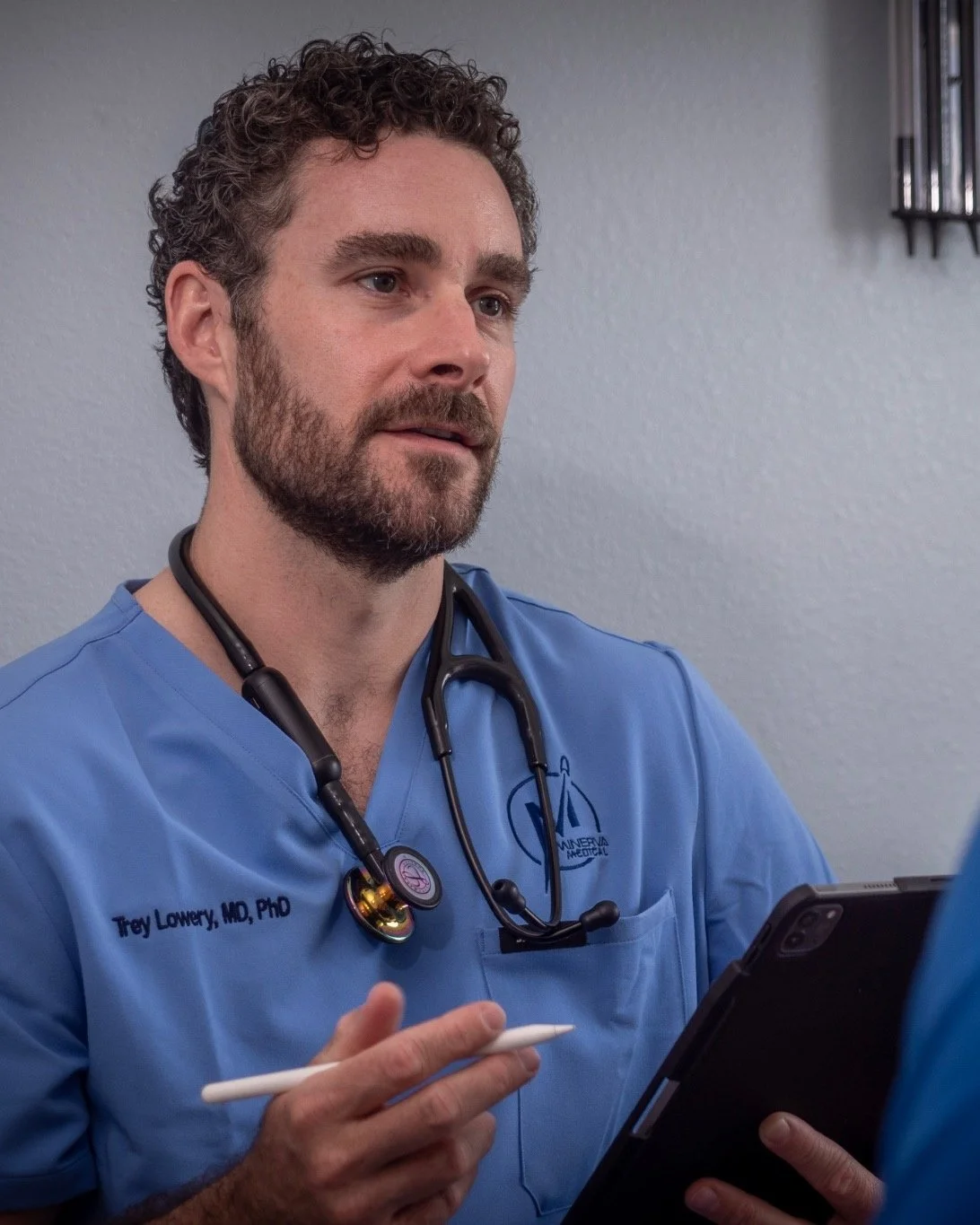
Dr. curtis “trey” lowery
Dr. Curtis "Trey" Lowery is the Chief Medical Officer of Minerva Medical Group and a physician operating at the intersection of emergency medicine, aerospace innovation, and extreme environment operations. As a space medicine physician working directly with commercial human spaceflight programs, he has supported medical operations and research efforts with organizations including NASA, SpaceX, Blue Origin, and VAST Space through the UTHealth Houston Space Medicine Fellowship. His work has included training 17 NASA astronauts in emergency medical care (including the Artemis 2 crew), astronaut medical screening and selection support, development of operational medical protocols, in-flight medical systems, and translational research focused on the physiologic adaptations required for long-duration human spaceflight. His experience places him at the forefront of one of the fastest-growing sectors in modern aerospace: operational healthcare for commercial space exploration.
Dr. Lowery brings a uniquely operational perspective shaped by years of leadership in disaster response, expedition medicine, and austere clinical care. He currently serves with Texas Task Force 1, Texas Task Force 2, and Texas Task Force 3 under FEMA's National Urban Search and Rescue Response System and previously served as Medical Team Leader for Tennessee Task Force 1. His field experience spans large-scale disaster operations, remote expeditionary medicine, and medical leadership in resource-limited environments where rapid decision-making directly impacts survival outcomes. He has practiced medicine aboard Arctic expeditions, supported remote international medical operations, and managed complex medical evacuations hundreds of miles from definitive care in some of the harshest environments on Earth. His international medical work includes serving in rural clinics on the island of Palawan in the Philippines at the start of the COVID-19 pandemic. Upon returning to the United States during the height of the crisis, Dr. Lowery continued working on the front lines as a resident physician in overwhelmed emergency departments during one of the most challenging periods in modern healthcare history. Those experiences reinforced his focus on resilient medical systems, operational adaptability, and leadership under uncertainty, principles that now directly inform his work in commercial spaceflight and extreme environment medicine.
In addition to his operational background, Dr. Lowery is a dual-trained physician-scientist with an MD/PhD from the University of Arkansas for Medical Sciences, where his doctoral research focused on translational biochemical mechanisms of acute thrombosis and thrombosis prevention. His scientific training continues to shape his evidence-driven approach to human performance, medical risk reduction, and physiologic adaptation in austere and extraterrestrial environments. This research foundation has become increasingly relevant as commercial spaceflight pushes humans farther from traditional medical infrastructure and requires new approaches to autonomous healthcare delivery.
Dr. Lowery is board-certified in Emergency Medicine and a Fellow of the American College of Emergency Physicians. He also completed advanced Bioastronautics training through the Aerospace Engineering Department at Texas A&M University, further strengthening his ability to bridge medicine, engineering, and operational systems design. His clinical and research interests include emergency medicine, hyperbaric and dive medicine, wilderness and expedition medicine, aerospace human systems integration, and operational healthcare infrastructure for the rapidly expanding commercial space industry.
Through Minerva Medical Group, Dr. Lowery is helping build a next-generation medical organization designed specifically for austere environments, frontier industries, and the future of human space exploration. His long-term vision centers on scalable operational healthcare systems capable of supporting humans at the edges of habitation, from remote terrestrial environments to future lunar and Martian settlements.